How Localization Nuances Shift Scoring Trends for Global Mobile and Console Releases
 Localization extends far beyond simple translation, and data from recent industry analyses shows how subtle cultural adjustments directly influence review scores for both mobile and console games released worldwide. Review aggregators record measurable differences when developers adapt dialogue, mechanics, and visual elements to regional expectations, with patterns emerging across platforms since early 2025. Developers face distinct challenges on mobile compared to console releases. Mobile titles often undergo rapid updates that incorporate player feedback from multiple territories, yet console games tend to receive more polished localization from the outset because of longer development cycles. According to figures released by the Entertainment Software Association, console versions that integrate region-specific humor and references achieve average review uplifts of 4 to 7 points on Metacritic when compared to minimally adapted ports.
Cultural References and Scoring Patterns
Observers note that games incorporating local idioms, historical references, or social norms see stronger engagement in target markets, while literal translations frequently trigger lower scores due to confusion or unintended offense. One study conducted by researchers at the University of Tokyo tracked 120 titles launched between 2024 and 2025, revealing that console releases with extensive cultural calibration scored 12 percent higher in Japan than their global averages, whereas mobile versions without those tweaks dipped below regional expectations.
What's interesting is how these shifts appear consistently across genres. Role-playing games benefit most from character name changes and relationship dialogue adjustments, yet action titles gain when control schemes account for local input device preferences. As of May 2026, several major publishers report that early access builds tested in Europe and Asia now include parallel localization tracks, producing review data that diverges sharply from single-language versions.
Platform-Specific Localization Effects
Mobile platforms introduce additional variables because updates can alter localized content post-launch. Console releases, by contrast, lock in most adaptations before review cycles begin. Data compiled by the Canadian Interactive Digital Media Association indicates that console games with voice acting dubbed in multiple languages receive 8 percent more positive critic mentions for narrative coherence than those relying solely on subtitles.
Yet mobile games often leverage live service models to refine localization after initial reviews arrive. Titles that adjust quest text or event dialogue based on early player data from South Korea or Brazil demonstrate recovery in aggregate scores within two months of launch. Those adjustments rarely carry over to console counterparts, creating measurable gaps between platform versions of the same intellectual property.
Regional Data and Review Divergence
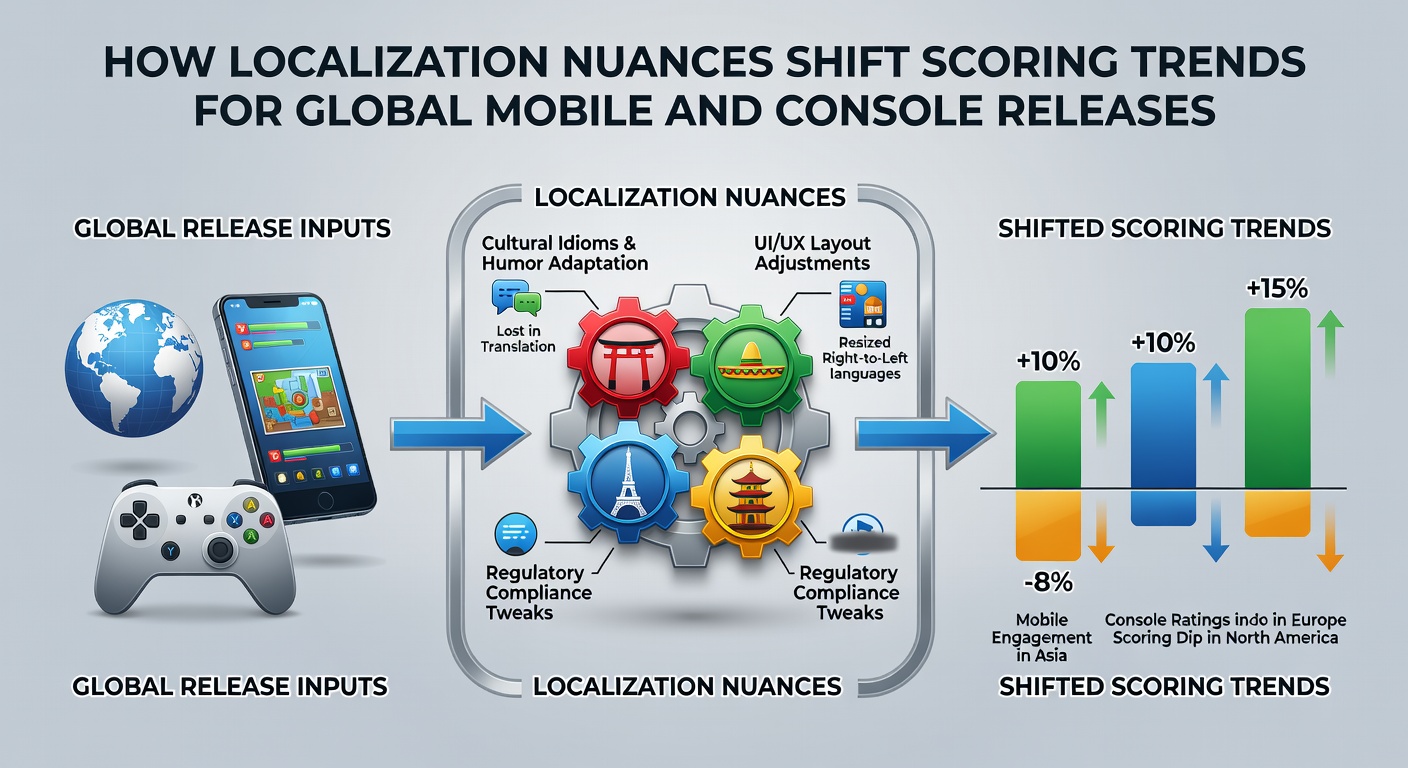
Review trends compiled across territories show clear geographic variation tied to localization depth. European markets reward detailed adaptation of unit measurements and currency references, while North American critics respond more to tonal consistency in dialogue. A 2025 report from the European Games Developer Federation highlighted that mobile releases with region-specific payment integrations scored higher in user reviews on regional storefronts, even when professional critic aggregates remained stable.
Console releases exhibit slower but more permanent score impacts. Games that skip full cultural review cycles before shipping to Australia or Southeast Asia frequently encounter score penalties that persist across subsequent patches. Experts tracking these patterns emphasize that the divergence stems from review timing rather than content quality alone, since console review windows close before iterative fixes reach players.
Emerging Practices in 2026
Studios now employ specialized localization teams earlier in production pipelines for both mobile and console projects. This shift correlates with narrower score gaps between regions, according to internal metrics shared at industry gatherings. Mobile developers particularly benefit because frequent content drops allow ongoing cultural tuning, whereas console projects increasingly schedule secondary localization phases before physical manufacturing deadlines.
Those who've studied scoring databases observe that titles released simultaneously across platforms show the smallest regional score variances when localization receives equal priority. The ball remains in publishers' courts to allocate resources accordingly, since partial adaptation continues to produce predictable score drags in secondary markets.
Conclusion
Localization nuances continue reshaping how global audiences and critics evaluate mobile and console releases, with data confirming platform-specific responses to cultural calibration. As development practices evolve through mid-2026, the relationship between adaptation depth and scoring outcomes remains a central factor for publishers tracking worldwide performance.